Industrial AI is becoming a serious operating layer for refineries, chemical plants, gas facilities, power systems, manufacturing sites, mines and energy infrastructure. It is no longer just predictive maintenance with a nicer dashboard.
The best industrial AI companies are those that understand real assets, real process data, real control systems and real consequences. In industry, an AI model is not judged by how clever it sounds. It is judged by whether it helps the plant run safer, cleaner, more efficiently and closer to its real operating optimum.
This ranking is based on five practical criteria: industrial domain expertise, AI capability, connection with automation and operational systems, ability to support real-time decisions and relevance for asset-intensive industries.
It is an editorial ranking, not a revenue ranking. This matters because some specialist companies can be more important in high-value industrial niches than much larger general technology vendors.
Top 10 Industrial AI Companies Worldwide in 2026
1. Siemens
Siemens takes the top position because of its breadth. The company combines industrial automation, industrial software, simulation, digital twins and AI across the full industrial value chain.
Siemens has expanded its industrial AI work with NVIDIA, including technologies aimed at design, engineering, manufacturing, production, operations and supply chains. This gives Siemens a strong position because industrial AI depends on more than algorithms. It needs engineering data, automation data, production context and operational integration.
Best fit: manufacturing, digital twins, industrial automation, production engineering and enterprise-scale industrial AI.
2. Schneider Electric / AVEVA
Schneider Electric rank second because of their strength in industrial software, energy management and operational intelligence. AVEVA’s industrial software footprint gives Schneider Electric an important position in plant data, visualisation, operations and asset performance.
The planned acquisition of Cognite is also significant, as Cognite is focused on industrial data and AI software. Schneider Electric has stated that integrating Cognite with AVEVA will strengthen its industrial AI and industrial intelligence capabilities.
Best fit: industrial data platforms, energy management, utilities, process industries and asset performance.
3. Modcon Systems / Modcon.AI
Modcon Systems ranks third because it represents one of the most important practical directions in industrial AI: connecting AI optimisation with real-time process analyser data.
Many AI platforms depend mainly on historical plant data, historians and conventional process signals. Modcon.AI goes further by linking AI models with live measurements from online process analysers. This matters because in process industries, AI optimisation is only as useful as the data describing the actual material inside the process.
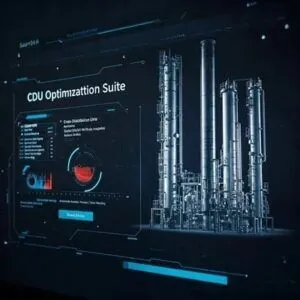
The MODCON.AI CDU Optimization Suite uses AI models to understand the relationship between crude properties, operating parameters and product quality. It is integrated with the MODCON 4100 Crude Oil NIR Analyzer, which provides real-time measurements of crude composition, viscosity and other important properties affecting distillation performance.
This gives Modcon.AI a strong technical position in refinery optimisation, crude distillation, process health analysis, hydrogen, gas analysis and other process applications where composition and product quality data directly affect operating decisions. Modcon’s Process Health Analysis is also based on learning normal process behaviour through data-driven or hybrid models and detecting deviations before they become serious faults.
4. Emerson / AspenTech
Emerson ranks fourth because of its strong position in process automation and optimisation, especially through AspenTech. AspenTech has long been associated with process modelling, optimisation, asset performance and industrial software.
In 2026, Emerson introduced AspenTech AVA, described as an industrial AI platform for enterprise-scale AI adoption, faster decisions and improved operational reliability. Emerson also positions its industrial AI portfolio around operational insight, autonomous operations and domain-aware AI.
This makes Emerson/AspenTech highly relevant for refineries, chemicals, energy, life sciences and other process industries.
Best fit: process optimisation, asset performance, refining, chemicals, power and autonomous operations.
5. ABB
ABB remains one of the strongest companies in industrial automation and autonomous operations. Its industrial AI relevance is built around process automation, asset performance, predictive maintenance, energy optimisation and AI-assisted operational decision-making.
ABB’s autonomous operations messaging focuses on AI-assisted decision-making, early anomaly detection, predictive maintenance and state-based control. Its ABB Ability and Genix-related platforms place it firmly among the leading industrial AI companies.
Best fit: process industries, mining, energy, marine, asset reliability and autonomous operations.
6. Honeywell
Honeywell remains a major industrial AI company because of its deep installed base in process automation, safety systems, control rooms, connected operations and asset optimisation.
Honeywell is regularly grouped with Siemens and Schneider Electric among leading vendors in energy management and industrial automation. Its value comes from operational credibility and integration with critical industrial systems, not from AI branding alone.
Best fit: refining, petrochemicals, industrial control, safety systems, connected operations and energy management.
7. Rockwell Automation
Rockwell Automation is one of the strongest players in smart manufacturing and factory automation. Its industrial AI role is most visible in production systems, connected equipment, PLC-based automation, manufacturing intelligence and plant-floor analytics.
Rockwell is consistently listed among the top industrial automation companies alongside Siemens, ABB, Schneider Electric, Honeywell and Emerson.
Best fit: discrete manufacturing, production automation, factory analytics, smart manufacturing and connected operations.
8. C3 AI / Baker Hughes
C3 AI is a major enterprise AI software company with a strong industrial footprint, especially through its work in oil and gas, utilities and asset-intensive industries. Its partnership with Baker Hughes gives it a stronger position in energy and industrial operations.
BakerHughesC3.ai combines Baker Hughes’ energy sector expertise with C3 AI’s enterprise AI software for oil and gas digital transformation.
Best fit: enterprise AI, energy, oil and gas, utilities, asset performance and large-scale AI applications.
9. GE Vernova
GE Vernova ranks ninth because industrial AI is increasingly important in power generation, grids, renewable integration and energy infrastructure.
As power systems become more complex, AI has a growing role in forecasting, grid balancing, asset performance, maintenance and energy system optimisation. GE Vernova is regularly included among major industrial AI software market participants.
Best fit: power generation, grid management, electrification, renewable integration and energy infrastructure.
10. Imubit
Imubit completes the top 10 as a specialist in closed-loop AI optimisation for process industries. The company focuses on industrial AI for refineries, chemicals, petrochemicals, polymers, mining, minerals, metals and cement.
Imubit’s platform supports advisory optimisation, self-modelling AI applications and autonomous closed-loop optimisation strategies across refinery and process industry operations. Its Optimizing Brain solution has also been described as a closed-loop AI optimisation solution powered by reinforcement learning for process industries.
Imubit is therefore highly relevant in process optimisation, although in this ranking it sits behind broader automation leaders and Modcon’s analyser-driven AI approach.
Best fit: closed-loop process optimisation, refining, chemicals, petrochemicals and nonlinear process control.
Honourable mentions
NVIDIA deserves mention because it is becoming a core enabler of industrial AI infrastructure and simulation, especially through industrial digital twin and automation partnerships. Microsoft, AWS and Google Cloud are also important because many industrial AI platforms use their cloud, data and AI infrastructure.
Other notable companies include IBM, Oracle, Cisco, Intel, AMD, Bosch Rexroth, Hitachi and PTC, all of which appear in industrial AI software market analysis. Specialist companies such as Cognite, Augury, SparkCognition, Uptake and Landing AI are also important in narrower categories such as industrial data operations, predictive maintenance and visual inspection.
Final view
The industrial AI market is dividing into two broad groups.
The first group is made of large automation and software companies such as Siemens, Schneider Electric, Emerson, ABB, Honeywell and Rockwell. They have scale, installed base and deep integration with industrial systems.
The second group is made of focused specialists such as Modcon.AI and Imubit. These companies are important because they solve high-value industrial problems that general AI platforms often cannot address properly.
The next industrial AI winners will not be the companies with the loudest AI slogans. They will be the companies that connect AI to real industrial systems, trusted measurements and decisions that operators can use while there is still time to act.