Badminton is one of the most popular indoor sports worldwide, requiring precision, speed, agility, and quick directional changes. While player skills are essential, the quality of the court surface plays an equally important role in ensuring performance, safety, and durability. Selecting the Best Badminton Court Flooring is therefore one of the most important decisions when planning a sports facility.
From professional academies and sports complexes to schools and community centers, the choice of flooring directly impacts player comfort, injury prevention, maintenance requirements, and court lifespan. Understanding the Best Badminton Court Materials can help facility owners make informed decisions that deliver long-term value.
This guide explores the most popular badminton court flooring options, construction considerations, official court dimensions, and the importance of working with experienced badminton court builders.
Why Flooring Matters in Badminton Courts
Badminton is a high-intensity sport involving rapid movements, lunges, jumps, and sudden stops. A poor-quality surface can lead to:
- Increased player fatigue
- Higher injury risks
- Uneven shuttle movement
- Reduced court lifespan
- Frequent maintenance expenses
The ideal badminton court surface should provide:
- Excellent shock absorption
- Consistent traction
- Smooth movement
- Long-term durability
- Easy maintenance
These characteristics are essential for creating a professional playing environment.
Understanding Official Badminton Court Measurement
Before selecting flooring materials, it is important to understand standard Badminton Court Measurement requirements.
Official badminton court dimensions include:
- Court Length: 13.4 meters (44 feet)
- Doubles Court Width: 6.1 meters (20 feet)
- Singles Court Width: 5.18 meters (17 feet)
- Net Height at Center: 1.524 meters
- Net Height at Posts: 1.55 meters
Adequate run-off areas around the court are also recommended to ensure player safety and smooth movement during competitive play.
Proper court dimensions combined with quality flooring create an optimal badminton experience.
Best Badminton Court Materials for Long-Term Performance
Several flooring systems are commonly used in badminton facilities. Each material offers different benefits depending on the intended use and budget.
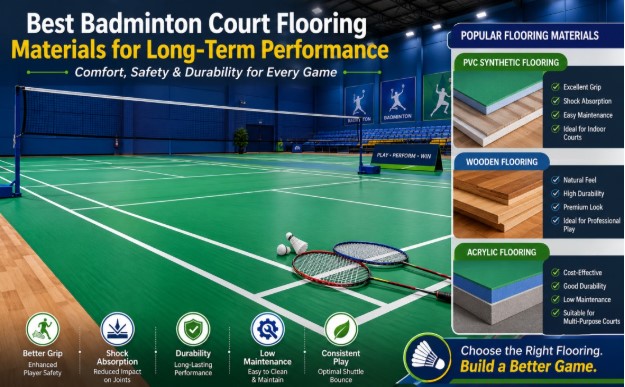
PVC Synthetic Sports Flooring
PVC flooring has become one of the most widely used solutions for modern badminton courts.
A high-quality synthetic badminton court typically utilizes PVC sports flooring installed over a concrete or wooden subfloor.
Advantages
- Excellent shock absorption
- Superior grip and traction
- Comfortable playing surface
- Reduced stress on joints
- Consistent player performance
- Easy cleaning and maintenance
PVC flooring is widely used in professional training centers and indoor sports academies due to its balance of safety and performance.
Best Applications
- Indoor badminton academies
- Sports clubs
- Schools
- Community centers
- Multi-court indoor facilities
For many indoor projects, PVC remains one of the Best Badminton Court Flooring options available.
Wooden Badminton Court Flooring
Wooden courts have long been considered the benchmark for professional badminton facilities.
Most international tournaments utilize wooden flooring systems designed to provide excellent player comfort and performance.
Advantages
Exceptional Shock Absorption
Wood naturally absorbs impact forces, reducing strain on knees and ankles.
Premium Playing Experience
Professional players often prefer wooden courts because they offer predictable movement and consistent performance.
Attractive Appearance
Wood flooring creates a premium visual appeal that enhances the overall facility environment.
Limitations
- Higher installation costs
- Requires regular maintenance
- Sensitive to moisture and humidity
- Periodic refinishing may be necessary
Best Applications
- Professional badminton arenas
- Tournament venues
- Premium sports clubs
- Elite training facilities
Although expensive, wood remains one of the Best Badminton Court Materials for high-level competition.
Acrylic Sports Flooring
Acrylic flooring is commonly associated with outdoor sports courts but is increasingly used in indoor multi-purpose sports facilities as well.
Advantages
- Durable surface
- Cost-effective installation
- Slip-resistant finish
- Attractive color options
- Low maintenance requirements
Limitations
- Lower shock absorption than PVC and wood
- Harder playing surface
- Less suitable for professional indoor badminton
Best Applications
- Recreational facilities
- School sports halls
- Multi-purpose indoor courts
Acrylic flooring can provide a practical solution when budget considerations are a priority.
Synthetic Badminton Court Systems
The term synthetic badminton court generally refers to modern sports flooring systems manufactured from engineered materials designed specifically for indoor sports.
These systems often combine:
- PVC sports flooring
- Cushion layers
- Shock-absorbing underlays
- Professional surface coatings
Benefits of Synthetic Court Systems
- Enhanced durability
- Consistent performance
- Reduced maintenance costs
- Improved player safety
- Long service life
For sports facilities seeking long-term value, synthetic court systems are becoming the preferred flooring choice.
Flooring Comparison for Badminton Courts
| Feature | PVC Flooring | Wooden Flooring | Acrylic Flooring |
| Shock Absorption | Excellent | Excellent | Moderate |
| Player Comfort | Excellent | Excellent | Moderate |
| Durability | High | High | High |
| Maintenance | Low | Moderate | Low |
| Cost | Moderate | High | Low |
| Professional Use | Excellent | Excellent | Limited |
| Indoor Suitability | Excellent | Excellent | Good |
While all three options have advantages, PVC and wooden systems generally provide the best balance of performance and player safety.
Best Badminton Court Construction Practices
Choosing the right material is only one aspect of successful Best Badminton Court Construction.
Several factors influence court performance and longevity.
Proper Foundation Preparation
A stable and level base prevents future flooring issues and structural movement.
Moisture Protection
Indoor courts should include adequate moisture barriers to protect flooring materials from damage.
Shock Absorption Systems
Modern sports flooring systems often include cushioning layers to improve comfort and reduce injury risks.
Professional Line Marking
Accurate line markings based on official Badminton Court Measurement standards are essential for recreational and competitive play.
Adequate Lighting and Ventilation
Court performance is enhanced when proper lighting and airflow systems are incorporated during construction.
Importance of Hiring Professional Badminton Court Builders
Many court failures occur due to poor installation rather than flooring material defects.
Experienced badminton court builders understand:
- Sports flooring technology
- Surface preparation techniques
- Moisture management
- Installation specifications
- Performance requirements
Professional builders can recommend the most suitable flooring system based on facility goals, budget, and expected usage.
They also ensure that construction meets industry standards and delivers long-term durability.
How to Choose the Best Badminton Court Flooring
Selecting the right surface depends on several factors.
Choose PVC Flooring If:
- You need excellent player comfort
- You want low maintenance
- The facility hosts regular training sessions
- Budget and performance must be balanced
Choose Wooden Flooring If:
- You want a premium professional court
- High-level competition is planned
- Appearance is a priority
- Budget allows for premium materials
Choose Acrylic Flooring If:
- Budget is limited
- The facility is multi-purpose
- Recreational play is the primary focus
For most modern indoor facilities, synthetic PVC systems continue to be among the Best Badminton Court Flooring solutions available today.
Conclusion
Building a badminton court is a long-term investment that requires careful planning and material selection. Evaluating the Best Badminton Court Materials helps facility owners create courts that deliver outstanding performance, safety, and durability for years to come.
Whether you choose PVC flooring, wood, or another synthetic badminton court system, following proper Badminton Court Measurement standards and partnering with experienced badminton court builders are critical steps toward successful Best Badminton Court Construction.
The right flooring system not only enhances player experience but also reduces maintenance costs and maximizes the return on investment for any sports facility.